 Expat life in Pingshan International Block
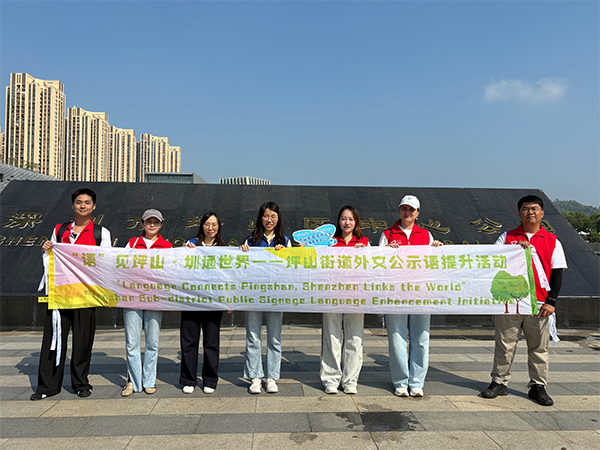
Volunteers pose for a group photo during Pingshan Subdistrict’s latest public signage improvement event on Oct. 21. Photos from Pingshan Subdistrict Office
Nine Chinese and international volunteers took part in the latest round of Pingshan Subdistrict’s public signage improvement campaign on Oct. 21. They checked and refined English-language signs to improve the quality of public signage and enhance the area's international image.
The volunteers split into two teams. One patrolled major roads, inspecting traffic signs, public-benefit advertisements and construction-site notices for translation accuracy and proper formatting. The other visited Pingshan Central Park and industrial parks to check guide maps and public reminders. They identified inaccurate translations, awkward phrasing, nonstandard wording and text that did not fit the context. They photographed the signs and compiled suggested revisions.
International volunteers drew on their language experience to flag unnatural phrasing and word choices, while local volunteers refined the wording to reflect Pingshan’s character and residents’ reading habits. Working together, they cross-checked the suggestions to ensure the signs were both idiomatic and locally appropriate.
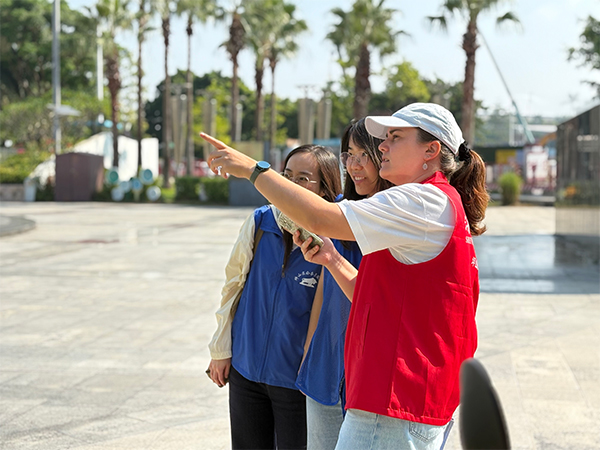
Christine Bubeck, a Brazilian volunteer, discusses with Chinese volunteers during the event.
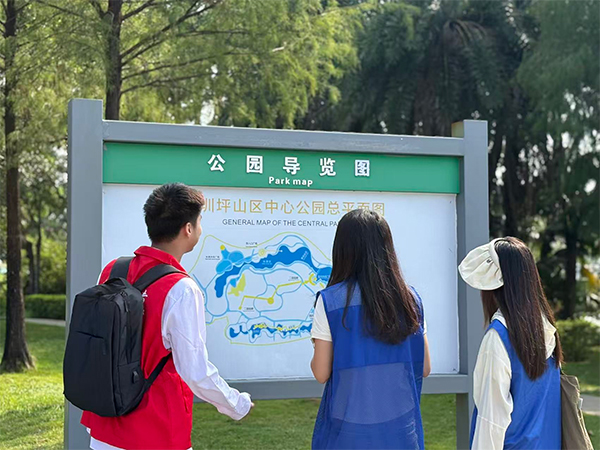
Volunteers inspect the English translation on a map at Pingshan District Central Park on Oct. 21.
“I usually walk past these signs without a second thought,” said a volunteer surnamed Qiu. “Only by joining the inspection did I realize how much detail goes into a small public notice. Being part of this effort and contributing to Pingshan’s international image feels meaningful.”
Many residents have noticed changes in Pingshan. “There are more standardized bilingual signs on the streets now, and things are improving in many areas,” a local resident said.
Christine Bubeck, a Brazilian volunteer who has lived in Pingshan for years, has taken part in several rounds of the campaign. She said the changes have been noticeable over the past few months: translation quality and consistency have improved markedly, making it easier to get around.
The campaign covers tourist and commercial areas, residential communities, industrial parks and major roads, reaching places where international residents work, live, shop and relax. It follows a process of “inspection, correction, review and improvement” to continue improving the quality of foreign-language signage and public information.
Pingshan Subdistrict plans to establish a regular inspection mechanism for foreign-language signage and encourage more Chinese and international volunteers to participate in community governance. The initiative aims to further improve the area’s foreign-language signage and related services, supporting Shenzhen’s goal of becoming an open, inclusive and welcoming international city.

ICP Registration Number: 粤ICP备17054870号-1
 Police Registration Number:44031002000124
Website ID: 4403910001
Government Service Hotline: 0755-12345
Website Technical Support:zwxx@szpsq.gov.cn
Sponsored by: General Office of CPC Pingshan District Committee (General Office of Pingshan District People's Government, Foreign Affairs Office of Pingshan District, and Archives Administration of Pingshan District)


 HOME
 PINGSHAN GOVERNMENT
 NEWS
 ABOUT PINGSHAN
 INVEST IN PINGSHAN
 LIFE
 SERVICES
 FAQ
 CHINESE
 FRANÇAIS
 日本語
 한국어